Wednesday, 26 February 2014

European Empires


By the 17th century, European trade with Asia was so important that the British, Dutch and French set up companies to control their interests. These companies laid the foundations for colonies. During the long reign of Queen Victoria, Britain became the world’s most powerful nation, ruling a huge empire.
The Dutch concentrated on the islands of Indonesia. The British and French fought over India until 1763, when the British East India Company took control of much of the country.
In the 1830s, the Dutch decided they wanted to control more than just trade with Indonesia, and so they started to oversee agriculture on the islands. They set up plantations to grow crops including coffee and indigo (a plant from which a blue dye is made). Enormous profits were made by Indonesian princes and Dutch colonists at the expense of the ordinary people, who no longer had the time or land to grow the crops they needed for themselves.
As well as controlling India, Britain also began to build up colonies in Southeast Asia. One of the earliest, in 1819, was Singapore on the tip of the Malay peninsula. By 1867, Malacca and Penang had also become British colonies, and, in 1896, the remaining Malay states formed a federation under British advisers. Ruling through the local sultans, the British controlled Malaya, setting up rubber plantations and tin mines. From 1824, Britain also tried to take control of Burma. The Burmese resisted, but were finally defeated in 1885.
THE CRIMEAN WAR
During the Crimean War (1853-56), Turkey, France and Britain fought against Russia. Thousands of British soldiers died from neglect and disease. Florence Nightingale and her team of nurses cleaned up the military hospitals and set up Britain’s first training school for nurses.
France, meanwhile, began to take control of Indochina (now Cambodia and Vietnam), and later added Laos.
Much of Britain’s wealth came from her colonies. Colonies and trading posts had been established in the 17th and 18th centuries in places as far apart as Canada, India, Australia and the Caribbean. More were added by the Treaty of Vienna at the end of the Napoleonic Wars. During Victoria’s reign, still more colonies were adding, including New Zealand, many islands in the Pacific and Atlantic oceans, parts of the Far East and large areas of Africa. At its greatest extent, in the late 19th century, the empire contained a quarter of the world’s land and a quarter of its people.
The colonies provided raw materials for British factories and a market for their goods. At first, some were run by trading companies, such as the East India Company in India. However, gradually they all came under direct rule from Britain. In many colonies, plantations were set up to produce tea, sugar, coffee, spices, rubber and cotton.


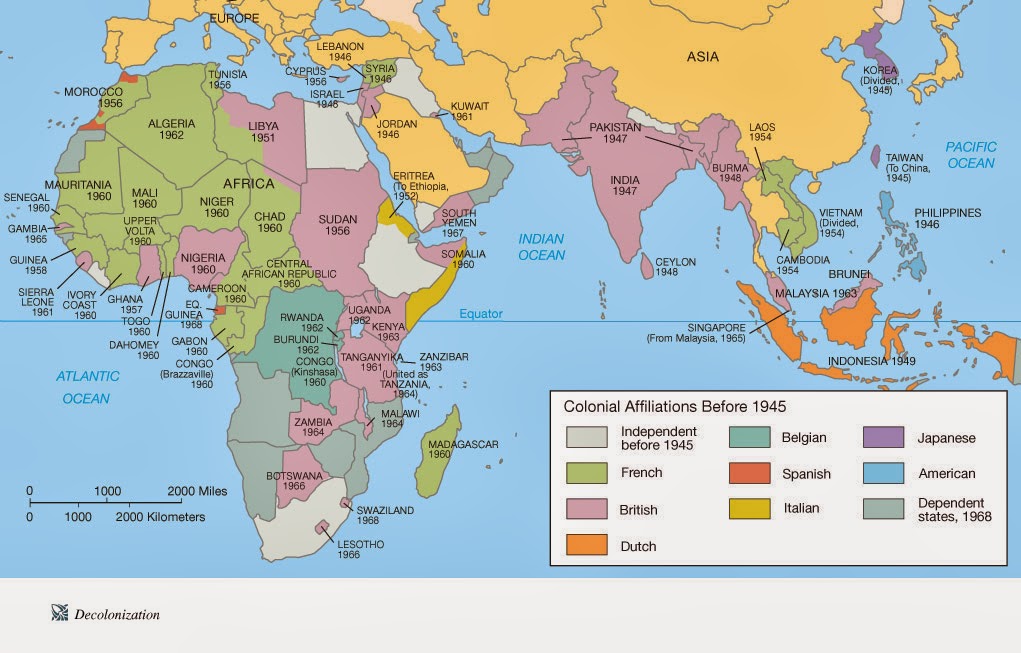
The British empire’s influence was worldwide, with other countries adopting British laws, technology and culture. During the 20th century, however, Britain’s influence declined and the country was no longer supreme as an industrial power. After World War II, the empire began to break up as countries sought independence.

Monday, 24 February 2014

Colonizing Africa


Although Europeans had been trading with Africa since the 16th century, they knew very little about the interior of the continent. They hardly ever ventured beyond the trading posts on the coast.
In Britain, curiosity about the interior of Africa grew, and, in 1788, an association was formed to encourage exploration and trade there. At the same time, many Europeans started to campaign against slavery. The British slave trade was abolished in 1807, with slavery finally ending throughout the British Empire in 1833. In 1822, Liberia was founded in West Africa as a home for free American slaves.
Christian missionaries travelled from Europe to Africa to set up churches and schools. Settlers also went to Africa, with most of them making for Cape Colony (South Africa), which the British captured from the Dutch in 1806. This was the largest European settlement in Africa.
Most of the colonists were Dutch farmers, known as Boers. In 1835, many of them were unhappy living under British rule, and they set off on the Great Trek into the interior. After much hardship they formed two new republics, the Transvaal and the Orange Free State. But when they reached the Zulu lands they came into conflict with the Zulus. Eventually the Zulus were defeated by the British in 1879.
Many British expeditions explored Africa’s interior along its great rivers. From 1768 to 1773, James Bruce explored Ethiopia, and, it two expeditions from 1795 to 1806, Mungo Park explored the Niger river. From 1852 to 1856, David Livingstone crossed the continent following the Zambezi river. In 1866,he set out to look for the source of the Nile, but lost contact with Britain for almost three years. An expedition led by Henry Stanley found him on the shores of Lake Tanganyika. Stanley went on to explore his own African empire. This was start of Europe’s scramble to control the entire continent.

Europe in Turmoil


In 1815, at the end of the Napoleonic Wars, Europe was in disorder. Old governments, with old ideas, were resorted, but a new age of industrialism and democracy was dawning. At first, people’s demands for change were either ignored or crushed. Revolution seemed the only weapon to people all across Europe who still had no say in how they were governed.
Revolt broke out in France in 1830, when Louis-Philippe was chosen as a ‘citizen-king’ to replace the unpopular Charles X. reports of the uprising spread, sparking off protests in other countries. Within two years, Greece declared its independence from Turkish rule, and Belgium from the Netherlands.
In 1848, so many revolutions and protest broke out throughout Europe that it became known as the ‘Year of Revolutions’. In Britain, the Chartists demonstrated for political reforms and votes for all men. In France, a group of rioters in Paris, who were demanding votes for all men and a new republic, were shot by soldiers. In Belgium, Denmark and the Netherlands political reforms were made peacefully.
In Germany, many people wanted all the German states to be united into one country, and Italians wanted a united Italy. In contrast, the many groups of people who made up the vast Austrian empire wanted the empire to be divided into separate states to reflect the many different cultures.
The revolutions in 1848 were crushed by the end of 1849. The ideas that drove them did not go away, however. Many governments realized that they would have to make some reforms. Reformers looked for new ways of governing and distributing wealth more fairly. The German socialists Karl Marx and Friedrich Engels published their ideas in The Manifesto in 1848. This was to have a huge impact on future events.

The Industrial Revolution


The Industrial Revolution began in Britain in the mid-18th century. Society was transformed as people moved from the countryside to the towns to work in factories.
Two events in the early 18th century helped to make the Industrial Revolution possible. The first was Abraham Darby’s discovery that coke was a better fuel than charcoal for smelting iron. The second was Thomas Newcomen’s invention of an improved steam engine, used for pumping water out of coal mines. It was now possible to produce more coal and better-quality iron for industry.
Until the 1760s, most goods were hand-made by people working at home or in small workshops. Metalworkers made nails, pins and knives, and spinners and weavers produced woolen and linen cloth. But the 1700s saw a rising demand for cotton cloth, which at first was imported from India. Later, raw cotton was imported, for manufacture into cloth in Britain.
In 1733, the invention of a flying shuttle speeded up the weaving process so much that spinning wheels could not produce enough yarn to keep the weavers supplied. Then, in 1764, James Hargreaves invented the Spinning Jenny, which allowed one person to spin eight threads at once. This was followed five years later by Richard Arkwright’s heavy spinning frame, which was powered by water.
Factories were built near fast-flowing streams to house these new machines, and the cotton industry boomed. By 1790, James Watt’s improvements to the steam engine meant that steam power could be used to drive machinery. This also increased the demand for coal to heat the water to make steam, and for iron to make the engines and other machinery. Canals (and later railways) were built to bring raw materials to the factories and take finished goods away. Towns grew rapidly, but housing and working conditions were often very poor and many people suffered from hunger, disease, or accidents at work.
SPINNING JENNY
James Hargreaves, inventor of the Spinning Jenny, was a poor spinner. He named his new machine after his daughter Jenny. Other hand-spinners feared his machines would put them out of work, and destroyed them.

Sunday, 23 February 2014

South American Independence


In 1800, Spain and Portugal still ruled vast areas of North and South America. Most local people hated being colonists, paying taxes to distant governments. After the Napoleonic Wars in Europe brought chaos to Spain and Portugal, the colonies decided to try to win their independence.
The main flight against Spanish rule was led by Simon Bolivar from Venezuela and Jose de San Martin from Argentina. San Martin gained freedom for his country in 1816, but Simon Bolivars fight was longer and more difficult. He had joined a rebel army that captured Caracas, capital of Venezuela, in 1810, but was then defeated by the Spanish. When he was defeated a second time, he went into exile in Jamaica. In 1819, he led an army over the Andes from Venezuela to Colombia, where he defeated the Spanish in a surprise attack at the Battle of Boyaca. In 1821, he freed Venezuela, and then in 1822 he freed Ecuador and Panama. He made them all part of a new state, called the Republic of Gran Colombia, with himself as president. Finally, Peru was liberated and part of it was renamed Bolivia after Bolivar.